Accident Prevention with Proper Pipe Marking
Complying with pipe marking standards is not just about avoiding OSHA fines.
While following the proper guidelines does prevent citations from regulatory bodies, clearly identifying the substances and flow direction within a system improves operational efficiency and can help prevent serious injuries and accidents.
The consequences of confusion
Ineffective or absent pipe markings can introduce a wide range of hazards in a facility. This is especially true when the pipe system contains hazardous contents like ammonia or other oxidizing chemicals.
- Accidental mixing: Poor pipe marking increases the risk of accidental mixing of chemicals when changing or turning a valve. Putting two incompatible substances into the same pipe could cause a reaction.
- Personnel exposure: Proper labeling alerts staff that PPE may be needed when working within that system.
While OSHA may not fine a company just for having unmarked pipes, the situation changes immediately if there’s an incident. Under the General Duty Clause, if a pipe is unmarked, contains hazardous chemicals and someone gets hurt, that can lead to a fine. Avoiding fines is good, but the primary goal is that everyone goes home safe at the end of the day.
Efficiency, emergency response and flow
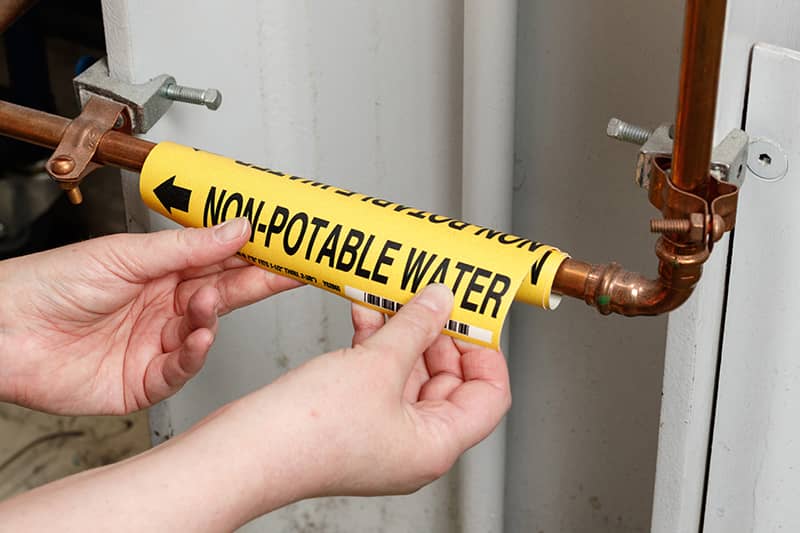
Using the ASME A13.1 standard — the industry consensus for identifying piping systems — provides immediate value in critical situations.
- Accelerated maintenance and troubleshooting: Clear markings ensure personnel know exactly what is in the pipe before they start working, which accelerates upgrades and simplifies routine repairs.
- Emergency response: Marking must facilitate efficiency, ensuring that any emergency response is as fast as possible. If first responders arrive at the scene, they need to know exactly what the situation is.
- Critical directional flow: The direction-of-flow arrow is critical for maintenance and any emergency response. The flow arrow helps determine the shutoff points and how to redirect the substance during maintenance. In an emergency, the flow arrow markings identify the correct line segment to isolate.
The value of rigorous consistency
A standards system only works if it’s clear and consistent.
- Placement: Markers must be placed strategically to be easily visible at all times, including at all valves, flanges and on both sides of wall penetrations. This ensures identification is not hidden behind equipment.
- Text: The text must be concise because excessive text will make the font smaller, and therefore harder to read from a distance.
- Color-coding and customization: While ASME A13.1 provides most color-coding guidance, some colors don’t have a set standard across industries. Purple, white, brown and black can be used at your discretion, but they should be consistent throughout your facility and documented within your safety plan.
With proper pipe marking, you turn a hidden network of building infrastructure into a clear, managed system. When systems are predictable and communication is clear, the industrial environment becomes much safer.