
3 Floor Marking Solutions for Refrigerated Food Production Facilities
Article Summary
Refrigerated food and beverage facilities face unique challenges when it comes to floor marking. Depending on the environment, there are generally three options.
- Paint: A long-lasting option with a high upfront investment.
- Floor Tape: Cost-effective and flexible, allowing for quick installation.
- LED Projectors: If physical marking is impossible, projecting lines can help improve safety and efficiency.
3 Floor Marking Solutions for Refrigerated Food Production Facilities
Marking a refrigerated food and beverage facility isn't as simple as laying down a line and walking away. The stakes are higher when the temperature drops, and if you don’t account for the environment, your investment will fail.
When planning your layout, you have to account for two primary factors:
- Temperature: Extreme cold affects bond strength, with standard adhesives often turning brittle and losing their tack in sub-zero temps
- Sanitation Standards: Markings must survive aggressive chemical cleaners and high-pressure washdowns without lifting or becoming harbors for bacteria
Let's explore three common solutions for floor marking in food and beverage facilities.
Option 1: Paint
Paint is often selected for its appearance, permanence and its ability to handle custom markings. However, in the refrigerated world, the biggest challenge isn't the finished product — it's the application and upkeep.
Key Considerations
Permanence
Paint is potentially the most permanent of the three solutions, and can make sense for static markings. But for facilities that change often, removing painted lines involves grinding or sandblasting — messy processes that are difficult to manage in a food-sensitive environment.
Flaking
Over time, the cycle of sub-zero temperatures and aggressive washdowns can cause paint to lose its bond. Once it starts chipping, it becomes a physical contaminant risk that auditors will flag.
Installation
Applying paint in a cold environment can be a massive undertaking. Condensation can ruin a bond before the paint even dries, often requiring production zones to be taken down for extended periods to ensure a proper cure.
Option 2: Floor Tape
For most facilities, floor tape is the most widely used and cost-effective solution. It allows updates to layouts without the dust and downtime of paint removal.
Key Considerations
Cold-Rated Adhesive
Success in freezing temperatures depends on the adhesive. Standard tape becomes brittle and loses its bond, but cold-rated adhesives like that found in ToughStripe® Cold Floor Tape are engineered to bond to the surface.
Edges
Look for low-profile tapes with tapered edges. This helps prevent forklifts from snagging the material and ensures moisture can’t seep underneath, which can be a contaminant area that harbors bacteria growth.
Rapid Deployment
You can mark entire aisles quickly and efficiently, especially with the assistance of the ToughStripe Floor Tape Applicator. If operations change, tape can be peeled up and replaced for minimal impact on schedules.
Option 3: LED Projectors
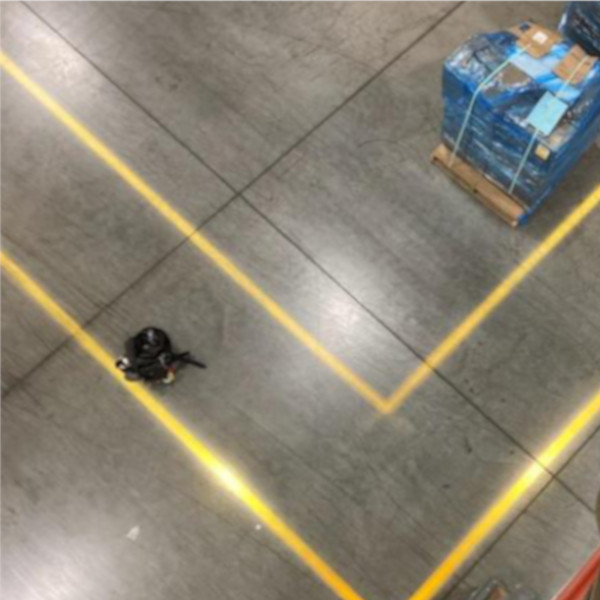
If a floor is rendered "unmarkable" due to temperature, moisture or dirt, look to the ceiling. Mounted LED projectors represent the next generation of facility safety and identification where physical solutions tend to fail.
Key Considerations
Sanitation
With no physical material on the floor, there's nothing to scrub, nothing to chip into your product, and nothing to harbor bacteria. In addition, solutions like Brady LED Sign and Line Projectors are waterproof, making them safe for washdowns that are common in food and beverage facilities.
High Visibility
You can project lines or full safety signs (like "Forklift Traffic" or "Stop") that remain bright and legible regardless of the floor condition or ambient light levels.
Power
These markings are dependent on your facility's electrical system. While they offer a high ROI through zero maintenance, they do require a power source to remain visible.
Build a tailored system with Brady
You don't have to choose just one method. Most facilities use a combination. For instance: projected lines for high-moisture loading docks, cold-rated tape for changing storage lanes or areas, and paint for static safety zones. No matter the method, the key is consistency. Regularly review your markings to ensure your visual workplace remains clear and compliant with all food safety standards.
You can find all three options and more in Brady’s comprehensive Floor and Area Marking Brochure.